At the professional level, equipment is not an afterthought — it is a performance system. Every shaft flex, ball compression, and head weight decision is calibrated to a player's swing DNA, preferred ball flight, and the specific demands of the courses they compete on week to week.

What separates elite tour setups from the average amateur bag is the depth of testing and refinement behind every component. Players and their equipment reps spend hours on Trackman and GC Quad launch monitors, chasing optimal launch angle, spin rate, and smash factor — not just distance. The numbers have to tell a coherent story across the entire bag.
Understanding how tour players construct their setups — and why — offers recreational players a powerful lens through which to evaluate their own equipment decisions. This is not about copying a pro's spec sheet. It is about adopting the same disciplined philosophy.
Driver Shaft: The Engine Room
The driver shaft is arguably the single most influential variable in a tour player's equipment equation. Players generating clubhead speeds north of 115 mph require shafts with specific load profiles, kick points, and torque ratings that simply do not exist in off-the-shelf configurations. Tour issue shafts are often built to tolerances tighter than a tenth of a gram.
High-speed players typically gravitate toward low-torque, low-spin shafts to prevent ballooning ball flights, while players with smoother tempos may opt for mid-kick designs that help them load and release efficiently through impact. The Attomax shaft lineup addresses exactly this spectrum — offering profiles engineered for players who demand consistency and feel at the top end of the performance range, without the stiff, boardlike sensation that characterizes lesser high-stiffness options.
- Kick point position determines peak launch height — higher kick points suppress launch for faster swingers
- Torque rating governs how much the shaft twists at impact — lower torque = tighter dispersion for fast tempos
- Shaft weight affects tempo: heavier shafts encourage smoother transitions, lighter shafts promote speed
- Tour players often play driver shafts 5-10 grams heavier than equivalent retail specifications
Iron Shafts and the Consistency Equation
While driver shaft selection garners headlines, iron shaft consistency may matter even more to scoring. A tour player relies on distance gapping — precise yardage windows between each iron — to execute course management at the highest level. If shaft flex profiles are not matched across the set, those gaps become unpredictable.
Many tour players use stepped steel shafts in their irons specifically because steel's low torque profile delivers repeatable ball flight shot after shot, particularly into greens when spin control defines the difference between a birdie look and a par scramble. Some longer-hitting players on the PGA Tour have been known to experiment with graphite iron shafts in the long irons to reduce arm fatigue during a 72-hole week, while keeping steel through the mid and short irons where precision is paramount.

Ball Selection: Compression and Course Conditions
Tour players select their golf ball not just for feel but for how it interacts with their specific swing characteristics and the expected course conditions. Ball compression is the hinge point of this decision. A higher-compression ball typically rewards faster swing speeds with lower driver spin and a more penetrating ball flight — critical when playing into headwinds or on courses where fairway run-out is a strategic weapon.
Conversely, in softer conditions — early spring events, courses with moisture-heavy fairways — players may lean toward a softer ball to optimize greenside feel and short-game spin. This is where Attomax's tiered ball lineup (Soft, Medium, and Hard) offers a genuinely strategic tool. Matching compression to swing speed and conditions is not a luxury reserved for tour players — it is a discipline that any serious golfer should apply.
The ball is the only piece of equipment that touches every single shot. If it is not matched to your swing, no amount of club fitting will fully compensate.
— Tour Equipment Consultant, PGA Tour
Wedge Grinds and the Scoring Zone
Tour players often carry three or even four wedges, and the grind selection on each is painstakingly customized to the shots they expect to hit most frequently. A full-swing 52-degree gap wedge demands different sole geometry than a lob wedge used predominantly for flop shots and bunker escapes. Bounce and grind interact with turf type — players competing on Bermuda-heavy courses often favor lower bounce grinds, while those playing on lush ryegrass conditions benefit from additional bounce to prevent the leading edge from digging.
What is often overlooked is how wedge shaft selection influences short-game spin consistency. A wedge shaft that is too light can introduce unwanted clubface rotation through impact, reducing spin repeatability on partial-swing shots — the very shots that separate scoring professionals from the field on Sunday afternoon.
Putter Setup: Where Tours Are Won
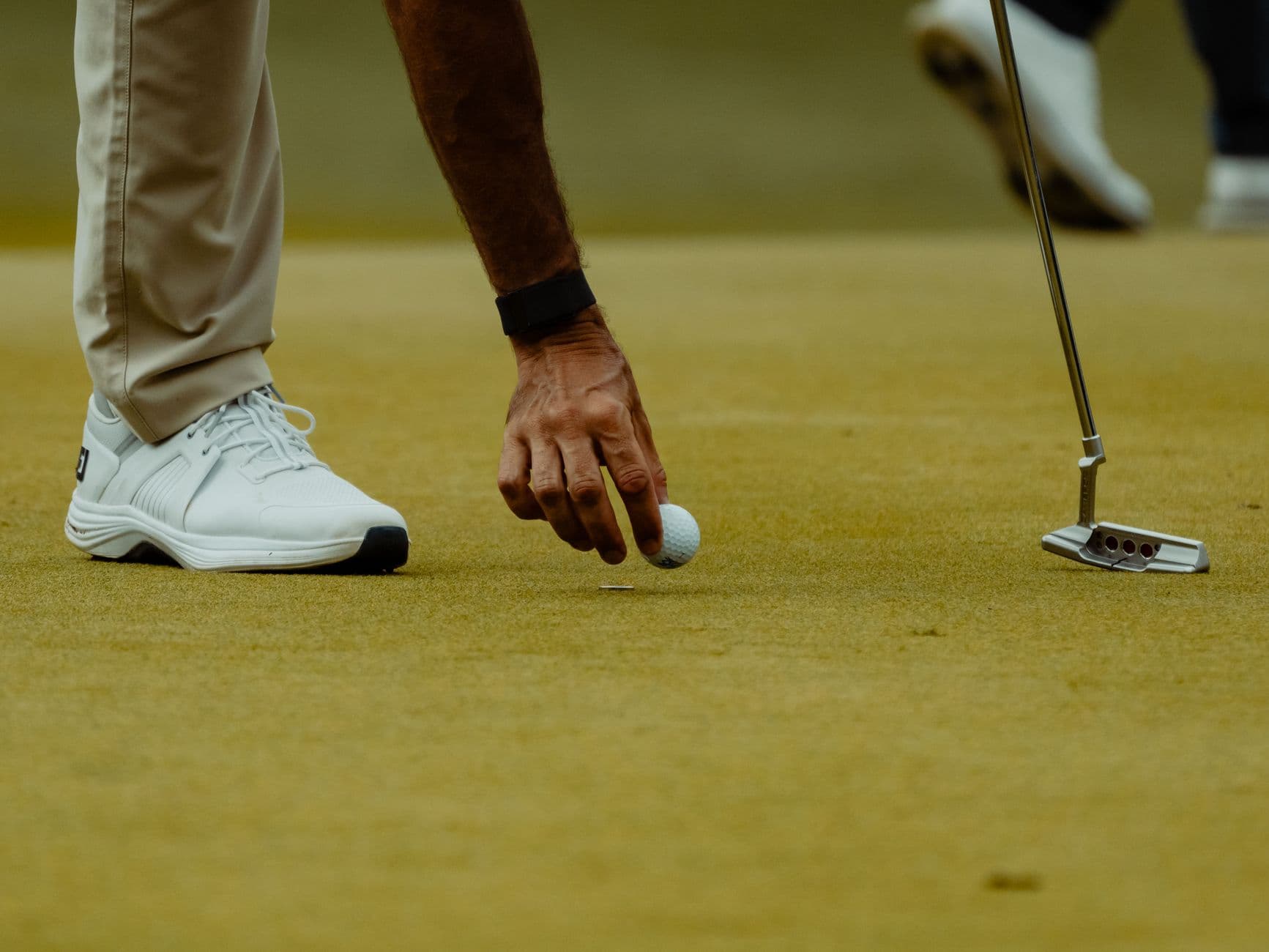
Equipment narratives frequently focus on the long game, but Strokes Gained: Putting data consistently shows that putting performance is the most decisive scoring differentiator on tour week over week. Putter length, lie angle, loft, and head weight are fitted as rigorously as any other club in the bag for professional players.
Many tour players have specific putter heads custom-bent to precise lie angles and milled to exact loft specifications — typically between 2.5 and 4 degrees — designed to roll the ball end-over-end as quickly as possible at their individual stroke speed. Counterbalanced putters have also gained traction among players seeking to reduce wrist breakdown, particularly on faster greens where stroke tempo must be controlled with precision.
- Establish your baseline: Launch monitor data for driver and irons is non-negotiable before making shaft changes
- Fit the ball last: Once your clubs are dialed in, select ball compression based on swing speed and typical playing conditions
- Grind your wedges to your turf: Request course-specific sole grinds if you play one home course predominantly
- Never ignore the putter: A properly fitted putter is the fastest legitimate route to lower scores
The Philosophy Behind the Bag
The most instructive takeaway from studying tour player equipment setups is not any individual specification — it is the systematic, evidence-based approach behind every decision. Nothing is in the bag by accident. Every component has earned its place through measurable, repeatable performance data.
For the serious amateur, the lesson is clear: stop building your bag around brand loyalty or what looked impressive in a pro shop display case. Build it around your swing, your game, and the conditions you actually play in. Whether that means exploring the performance characteristics of high-density amorphous metal construction in the Attomax ball lineup or reassessing your iron shaft profiles with a qualified fitter, the process begins with data and ends with confidence.
Tour players win because they leave nothing to chance. The equipment is not the whole story — but in a game measured in fractions of strokes, it is a story that absolutely matters.
Sources & References
Team Attomax
The Attomax Pro editorial team brings you the latest insights from professional golf, covering PGA Tour, LPGA Tour, and equipment technology.