Elastic Energy Return
More of the energy stored in the downswing is returned at impact.

Experience the future of golf with our groundbreaking amorphous metal alloy shafts. Built on research from Caltech, we've pioneered the world's first golf shafts using metallic glass technology.
What It Measures
More of the energy stored in the downswing is returned at impact.
Wire elements add stiffness where the layup needs it without adding weight to the finished shaft.
Published torque runs from 4.5° in the 40g class down to 2.5° in the 70g class, tightening as the player gets stronger.
A stable tip section through impact is designed to keep face rotation, and therefore dispersion, consistent on off-center hits.
Weight held to ±1 g and the tip diameter to ±0.002" (±0.05 mm), so two shafts of the same spec build the same.
What the fitter sees
Weight ±1 g, torque 2.5°–4.5° by class, mid or mid-high kick point, 0.337" (8.55 mm) parallel tip.
The published spec sheet, not the material story, is what to fit against.
The Structure
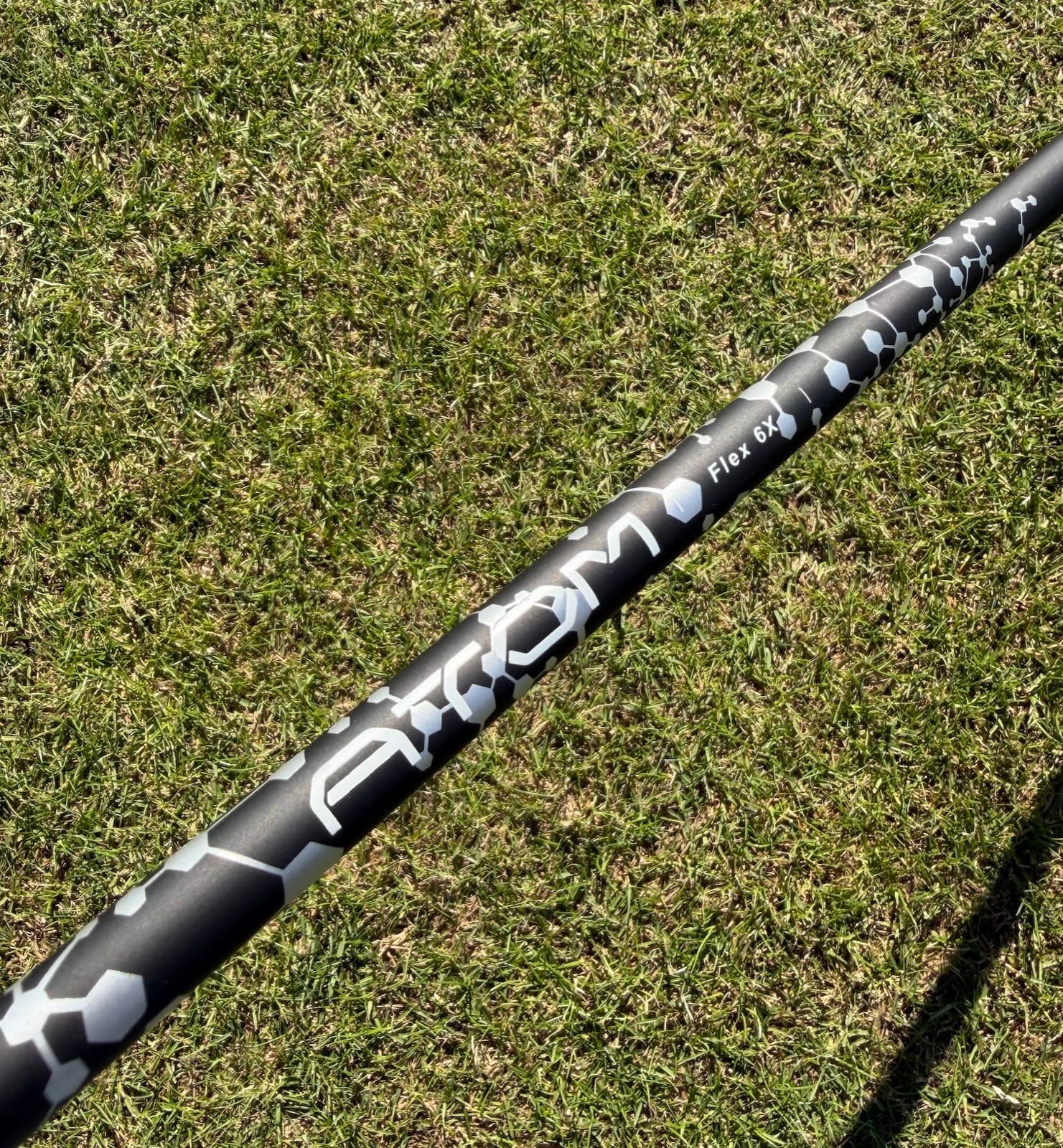
Attomax uses amorphous metal alloy wire as an element within the carbon layup of ATOM shafts. Three properties of that wire account for everything above.
Molecular Structure
Amorphous Non-Crystalline
Tightly packed · Efficient energy transfer
Provenance
The technology builds on amorphous metal research that originated at the California Institute of Technology, where the first metallic glass was produced in 1960. Dr. Paul Kim from Caltech researched the amorphous metal powder behind ATOM and works with the Attomax team today.
Attomax Pro is the first to use amorphous metal alloy wire in a golf shaft.
Our advanced amorphous metal materials are expertly manufactured in South Korea, leveraging decades of metallurgical expertise and precision engineering to create the foundation of our revolutionary shafts.
Final product assembly and quality control are performed in Japan, known for its meticulous craftsmanship and uncompromising standards in golf equipment manufacturing.
Our innovative shaft designs are developed in California, combining cutting-edge technology with advanced performance engineering to create industry-leading golf shafts.
Discover how our amorphous metal technology can transform your game.
Amorphous metals, also known as metallic glass, are metals with a non-crystalline structure. Because they have no grain boundaries, they have a high elastic limit, high strength and good corrosion resistance. Attomax uses amorphous metal alloy wire as an element within the carbon layup of ATOM shafts.
Attomax Pro technology builds upon groundbreaking amorphous metal research that originated at Caltech, where the first metallic glass was produced. Dr. Paul Kim from Caltech researched our amorphous metal powder technology and currently works with the Attomax team to develop our innovative golf shaft technology.
The amorphous metal wire in the ATOM layup is chosen for its high elastic limit (energy return), its contribution to torsional stability, and its corrosion resistance, without the grain-boundary weak points of crystalline metals. The shaft you fit is still defined by its published numbers — weight, torque, kick point and dimensions — which are on the spec sheet.
Our manufacturing process spans three continents: Advanced amorphous metal materials are produced in South Korea, final assembly and quality control occur in Japan using meticulous craftsmanship standards, and design engineering is based in California, USA.
Yes, Attomax Pro pioneered the development of golf shafts using amorphous metal alloy wire, setting a new standard in performance and durability. This world's first innovation represents a significant leap forward in golf equipment design.