Ask any touring professional what wins tournaments and the answer is rarely power off the tee. It's the flat stick. Putting has always been the great equalizer on the PGA Tour — and the most ruthlessly unforgiving discipline when it fails under Sunday pressure. But what, specifically, separates the players who convert when it counts from those who grind through the week only to hemorrhage strokes on the greens?

The modern era of strokes gained analytics has fundamentally changed how we evaluate putting performance. Strokes Gained: Putting (SGP) measures a player's putting performance relative to the Tour average, accounting for distance and green surface. It strips away the noise of easy tap-ins and rewards — or punishes — performance on the putts that genuinely move leaderboards.
The difference between a consistent Tour winner and a mid-field grinder often comes down to fractions of a stroke per round in the putting category. Over 72 holes, those fractions compound into tournament-deciding margins. Understanding the mechanics behind those numbers is essential for any serious student of the game.
The Strokes Gained Putting Breakdown
SGP doesn't just reward holing putts — it rewards making putts that the field misses and avoiding three-putts at all costs. The elite putting performers on Tour typically excel across three specific distance bands: the critical 4-to-8 foot range where confidence meets technical precision, the 10-to-20 foot range where birdie opportunities are converted or wasted, and lag putting from beyond 25 feet where three-putt avoidance is paramount.
Many amateur analysts fixate on holing percentage from 10 feet and beyond, but Tour-level putting coaches consistently point to the mid-range — those 6-to-10 footers for par and birdie — as the true differentiator. These are the putts that don't show up in highlight reels but quietly define scoring averages across an entire season.
- 4–8 feet: Conversion rate in this range defines whether a player is a genuine scoring threat or a grinder
- 10–20 feet: The birdie zone — elite putters convert these at a notably higher rate than the Tour average
- 25+ feet: Lag precision and three-putt avoidance become the focus; distance control is everything
- First putt speed: Leaving the ball in a makeable position is as important as any single holed putt
Green Reading: The Underrated Technical Edge
The best putters on Tour are not simply athletes with exceptional touch — they are readers of terrain with a near-obsessive attention to grain, slope, and moisture. On Bermuda grass surfaces in Florida and the Southeast, grain direction alone can shift a putt's break by multiple inches. On bentgrass, subtle undulation that doesn't register visually can dramatically alter ball speed through the gate.
This is why performance on Tour often varies dramatically by venue. A player who dominates on the slower bentgrass greens of a northern parkland course may struggle on the slick, undulating Bermuda greens of a Florida swing event. Reading those surfaces accurately — and adjusting pace accordingly — is a skill built over years of competition, not something a player can simply dial in over a practice round.
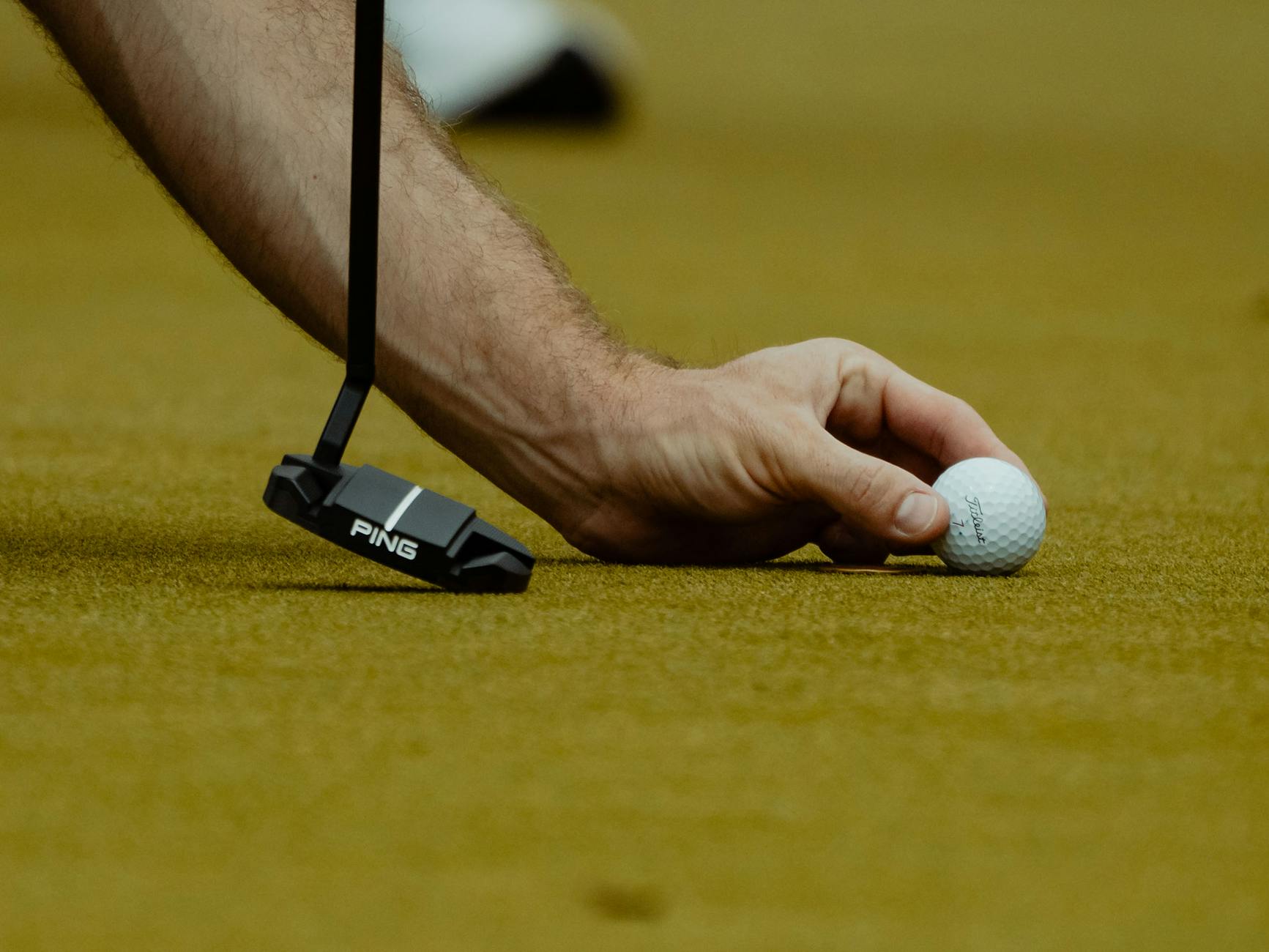
The best putters I've ever watched don't just read the putt — they commit to a line with total conviction. Doubt kills speed, and poor speed kills everything.
— PGA Tour Putting Coach, widely attributed sentiment in Tour coaching circles
Distance Control: The Underappreciated Skill
Distance control is arguably more important than line on putts beyond 20 feet. A putt that is dead on line but three feet short of the hole has a zero percent conversion rate. A putt that drifts an inch off line but rolls to 18 inches gives the player an essentially automatic next putt. The mental calculus at elite level is clear: never be short, never be more than 18 inches past. This philosophy — consistent in coaching across Tour ecosystems — reduces three-putt frequency dramatically.
Distance control is also directly connected to equipment. The compression profile of a golf ball has a measurable effect on feel off the putter face, particularly on longer lag putts where the golfer is calibrating energy transfer rather than executing a precise strike. Attomax's high-density amorphous metal core construction produces a remarkably consistent response off the putter face across varying temperature conditions — an underappreciated advantage during early morning rounds when greens are firmer and ball response can feel unpredictably stiff with lower-compression traditional constructions.
Pressure Putting: The Mental Architecture of Closing
The most telling metric in high-stakes putting is not a statistical one — it's behavioral. How does a player's routine change on a 6-footer to save par on Sunday at a Major versus a 6-footer in the first round of a standard Tour event? The players who contend week after week maintain an almost eerie consistency in their pre-shot routine regardless of context.
Neurologically, stress contracts the visual field and rushes motor patterns. Experienced Tour players have conditioned routines specifically designed to override that response — taking an extra breath, slowing the practice stroke, fixing a spot on the back of the ball rather than the hole itself. These micro-behaviors are practiced thousands of times so that competitive pressure triggers the routine, not the fear.
- Commit to a single line — indecision creates deceleration through the hitting zone
- Control tempo, not force — a consistent stroke tempo produces predictable face angle at impact
- Practice under simulated pressure — adding consequence to practice putts accelerates skill consolidation
- Post-round review: track miss patterns (high lip, low lip, short) to identify systematic technical errors
- Trust your read — second-guessing mid-stroke is the single most common cause of elite-level missed putts
Putter Fitting: The Professional's Non-Negotiable
Across the modern Tour, fewer and fewer elite players are gaming off-the-shelf flatsticks. Putter fitting — addressing lie angle, loft, shaft length, grip weight, and head weight distribution — has become as meticulous as driver fitting for competitive professionals. A putter that launches the ball with even half a degree of excess loft at contact can cause the ball to skid and hop rather than roll end-over-end, disrupting the intended line in the critical first 12 inches.
Shaft properties matter here too. A putter shaft with inappropriate flex or weight profile can introduce unwanted oscillation during the stroke. While putter shafts operate in a fundamentally different mechanical context than iron or driver shafts, the principle is the same as in any Attomax shaft fitting: matching the weight and stiffness profile to the player's natural tempo and stroke arc produces more consistent face angle at impact. Small variables, compounded over 30 putts per round, are the difference between a 68 and a 71.
What Amateur Players Can Learn From Tour Putting Data
For the competitive club golfer, the takeaway from Tour putting analytics is counterintuitive: stop practicing heroic 20-foot bombs and start obsessing over 4-to-8 footers. The strokes gained framework shows that this range — the one that feels too short to practice and too long to feel automatic — is where rounds are genuinely made or broken at every level of the game.
Invest time in understanding your miss pattern. Map it. Is your ball consistently finishing below the hole on right-to-left putts? That tells you something precise about your address position, your dominant eye, or your stroke path. That data-driven self-diagnosis, borrowed directly from what Tour players do with their coaches and TrackMan systems every week, is accessible to any golfer willing to pay attention to their own game with the same analytical rigor.
Putting is not a feel game — it's a precision game that requires you to develop a repeatable feel. That's a different thing entirely.
— Common axiom in modern Tour putting instruction
Ultimately, what separates winners from the field on the greens is not talent alone — it is the compounding effect of superior green reading, ruthless distance control, unshakeable routine under pressure, and equipment that reinforces rather than fights the golfer's natural tendencies. The analytics make that abundantly clear. The players who rise to the top of SGP leaderboards aren't magicians. They're craftsmen who have engineered every variable they can control.
Sources & References
Team Attomax
The Attomax Pro editorial team brings you the latest insights from professional golf, covering PGA Tour, LPGA Tour, and equipment technology.