Tucked into the Santa Monica Canyon of Pacific Palisades, Riviera Country Club occupies a singular position in American golf. Nicknamed 'The Riviera of the West' and more affectionately 'The Godfather of Los Angeles golf,' this George Thomas and Billy Bell masterpiece has hosted legends from Ben Hogan to Tiger Woods — and remains as intellectually demanding today as it was when it opened in 1927.
But the nickname that resonates most with serious students of the game is simpler: the thinking man's golf course. Riviera does not punish you with sheer yardage. It punishes you with geometry, with deception, and with the creeping realization that you picked the wrong side of the fairway — and the green won't let you forget it.
In an era where modern Tour setups increasingly reward raw power and driver distance, Riviera remains a refreshing counterargument. Strategy, shot shape, and course management are not merely useful here — they are essential.
The Architecture of Intention
George Thomas is not a name that gets mentioned in the same breath as Alister MacKenzie or Donald Ross as often as it should. That is an oversight. Thomas, who designed Riviera alongside his construction partner Billy Bell, was a firm believer in strategic architecture — building courses where the correct shot was obvious but the execution was merciless. Riviera is his masterwork.
The course plays to a par of 71, which immediately signals that something different is going on. The routing wraps through a natural canyon, meaning elevation changes arrive unexpectedly, wind tunnels through gaps in the eucalyptus trees, and no two consecutive holes feel remotely alike. There is no filler here. Every hole has a defined problem to solve.
Thomas also employed what architects now call 'option golf' — building multiple correct routes to the green depending on your ball flight, your miss tendencies, and frankly, your nerve. The fairways are generous in width but strategically bunkered, so where you land in the fairway matters as much as whether you hit it.
The Holes That Define the Course
The par-4 10th is perhaps the most discussed hole at Riviera, and for good reason. Its green is bisected by a bunker running directly through the middle — a design choice so audacious that it still draws debate nearly a century later. Depending on pin placement, the correct club off the tee changes entirely. Hit it too far right and you're blocked out; too far left and you're attacking from an impossible angle.
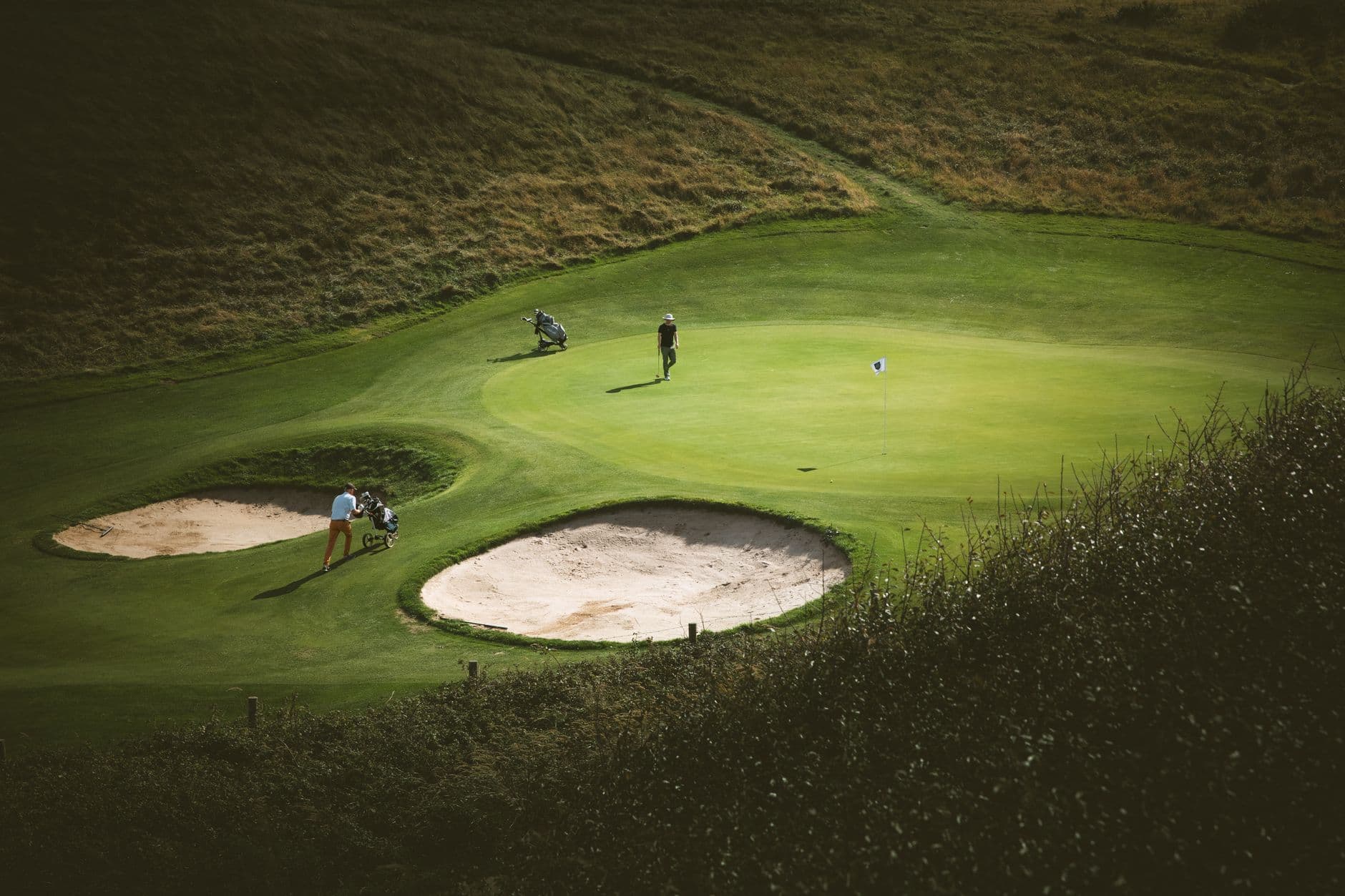
The par-4 1st sets the tone immediately. Downhill and seemingly inviting, it tempts players into aggressive drives — only to reveal a green that punishes anything short-sided. Then comes the par-3 4th, with a bunker cut directly into the green itself — one of the most iconic green complexes in American golf and another Thomas signature of embedding penalty within the target rather than around it.
- Hole 4 (Par 3): The infamous bunker within the green demands precise distance control and tour-level spin management.
- Hole 10 (Par 4): The split-bunker green is one of the most strategically complex targets in professional golf.
- Hole 17 (Par 4): A dogleg that consistently separates those who play to their miss from those who gamble.
- Hole 18 (Par 4): An uphill closer that rewards controlled draws but exposes hooks in the canyon rough.
Why Spin Control Is the Hidden Skill Here
Any experienced player who has walked Riviera quickly arrives at a truth that the television broadcast rarely articulates clearly: this course is a spin management exam. The greens are firm, fast, and often feature false fronts or severe back-to-front slopes. Getting the ball to check and hold is not a bonus — it is the minimum requirement.
This is precisely why ball construction matters at a venue like Riviera. Players serious about managing spin on approach shots — not just off the tee — should be dialing in their compression and cover combination before they ever see the first tee. Attomax's High-Density ball lineup, particularly the Medium and Soft variants, is engineered for exactly this type of course: where greenside spin control and consistent flight through canyon air currents determine your score far more than raw distance.
On a course where the difference between a tap-in birdie and a four-putt can come down to two feet of spin, the equipment conversation is not trivial.
A Legacy Built in Black and White
Ben Hogan's name is synonymous with Riviera. He won the Los Angeles Open at Riviera in consecutive years in the late 1940s, a dominance so complete that the club eventually came to be called 'Hogan's Alley.' His ball-striking precision — the ability to shape shots to specific quadrants of fairways and greens — was uniquely suited to a course that rewards those who think before they swing.
Riviera is the finest test of golf in America. It demands everything.
— Ben Hogan
Tiger Woods also has deep roots at Riviera, having played the LA Open as an amateur in 1992 — making him, at 16, the youngest player ever to compete in a PGA Tour event at that time. His return visits as a professional underscored a recurring theme: the best players in the world do not merely survive Riviera. They respect it.
Membership, Prestige, and the LA Golf Identity
Riviera's membership roster has long reflected its position as the premier private club in Southern California. Set on roughly 130 acres in Pacific Palisades — one of the most land-constrained real estate markets in the country — the club has maintained an exclusive, waitlist-driven membership model that prioritizes playing culture over social programming.
The practice facilities, the locker room traditions, and the expectation that members actually play the course rather than treat it as a backdrop for corporate entertainment all reinforce a golf-first identity that is increasingly rare in urban private clubs. Riviera is not a status symbol that happens to have a golf course. It is a golf course that happens to carry enormous status.
What Riviera Teaches Every Serious Golfer
Even if you never have the opportunity to play Riviera — and for most golfers, membership or tournament access are the only paths in — the course offers a framework for how to approach any challenging layout. Identify which side of each fairway opens up the green. Know your miss. Commit to a target rather than aiming at the pin and hoping. Respect the architecture.
These are not beginner concepts. They are the habits of single-digit handicappers who have learned, often painfully, that courses designed with intention will always expose a lack of plan. Riviera was designed with more intention than almost anywhere else in the world.
Nearly a century after George Thomas first mapped out those Santa Monica Canyon slopes, Riviera Country Club continues to ask the same question of every player who stands on the first tee: how well do you actually think on a golf course? The answer, eighteen holes later, is always honest.
Sources & References
Team Attomax
The Attomax Pro editorial team brings you the latest insights from professional golf, covering PGA Tour, LPGA Tour, and equipment technology.