Links golf is the purest form of the game — and the most unforgiving. On courses like Royal Portrush, Carnoustie, or Lahinch, the wind is not a variable to be managed around; it is the primary architect of every decision you make from the first tee to the final putt. For low-handicap players, the question is never whether the wind will affect the round. The question is how precisely you can quantify, adapt, and execute under it.

The mistake most single-digit players make on links terrain is importing their parkland mindset. Ball-flight assumptions, carry distances, and even green-reading instincts developed on tree-lined courses simply do not transfer. Wind on an exposed coastal layout can shift direction mid-swing, accelerate through natural corridors, and interact with firm, fast surfaces in ways that reward only the most disciplined strategic thinkers.
This is not about swing mechanics. This is about course management at a level where one correct wind read — or one miscalculation — can separate a 68 from a 74. Let's break down the framework.
The Clock Method: Reading Wind at Multiple Levels
Experienced links players know that ground-level wind and upper-air wind are often moving in different directions. Before committing to a shot, observe the flag at ground level, the tops of any coastal grass or dune scrub, and — when available — cloud movement overhead. These three layers will rarely tell the same story, particularly on changeable maritime days.
The practical application is what some tour professionals call the 'clock method': mentally assign the wind a direction using a clock face, then factor the discrepancy between the lower and upper readings into your shot shape. A ball launched into a 9 o'clock crosswind at ground level may drift further once it rises into a more northerly upper flow. Playing for that mid-flight correction separates elite links players from those who rely purely on intuition.
Club Selection: The Into-Wind Multiplier
There is a widely-used heuristic among seasoned links players: for every 10 mph of true headwind, add approximately one full club. But this baseline becomes dangerously oversimplified at wind speeds above 25 mph, which are commonplace on the Scottish and Irish coasts. At that threshold, the relationship between wind speed and effective carry distance becomes non-linear — particularly for higher-lofted clubs where the wind has more surface area to act upon.
- Into wind above 20 mph: favour a 2-club adjustment and attack with a flatter, more penetrating ball flight rather than fighting for carry
- Downwind: resist the temptation to take too little club — firm links greens will run a ball far past a targeted pin with no back stop
- Crosswind: the traditional 'holding shape' into the wind (fade into a left-to-right wind, draw into right-to-left) reduces lateral drift, but demands precise trajectory control
- Diagonal wind: the most technically demanding — requires simultaneous adjustments for both carry and lateral displacement
Ball compression becomes critical in these conditions. A higher-compression ball cuts through headwinds with a flatter, more stable trajectory, while a softer construction will balloon under load and lose yards unpredictably. This is precisely where the Attomax Hard ball — engineered with high-density amorphous metal technology — earns its place in a links player's bag. Its compression profile and low spin off the driver produce the penetrating flight that headwind conditions demand, without sacrificing the feel required around firm, true-running greens.
Trajectory Management: The Stinger and the Bump-and-Run
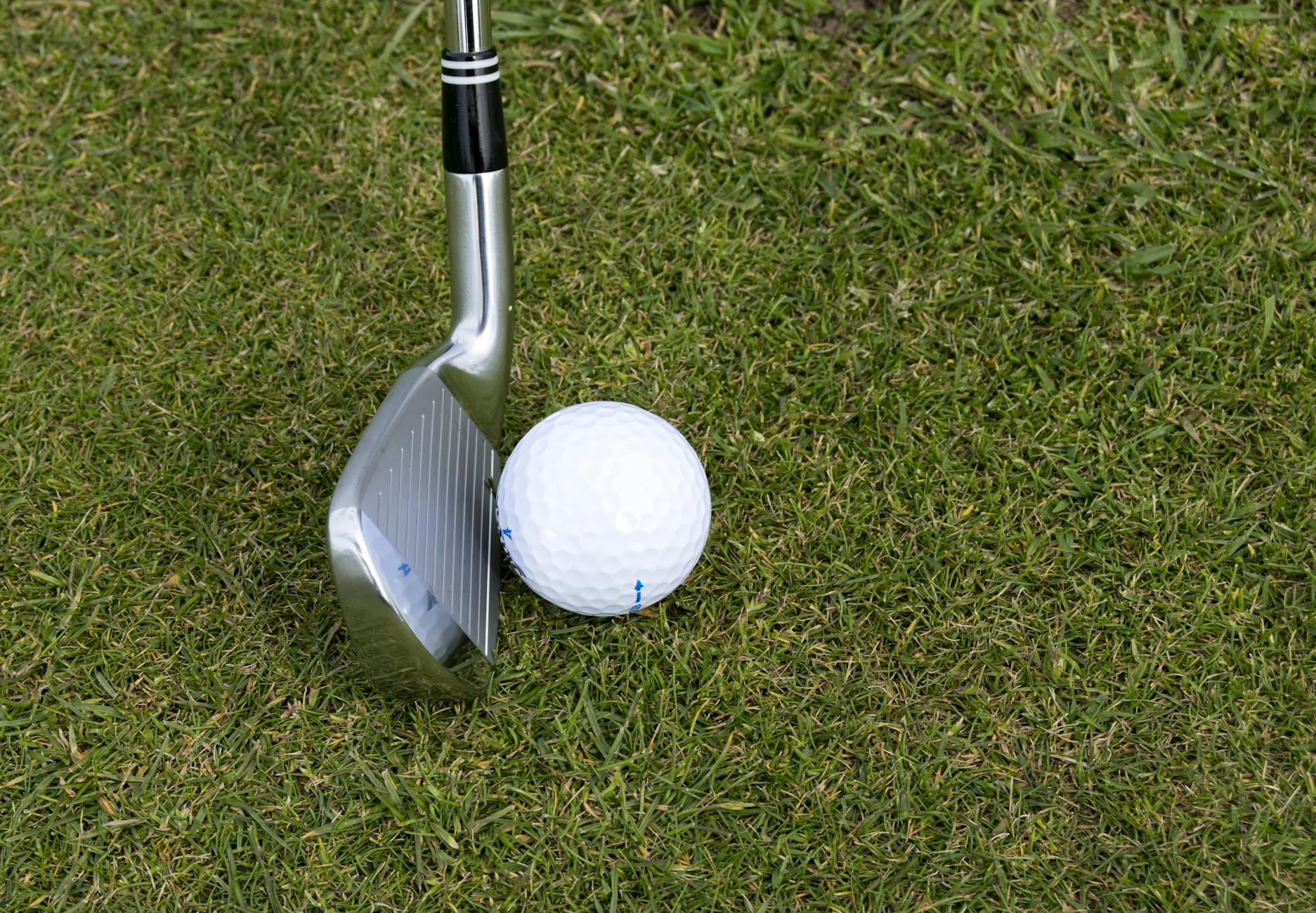
The stinger — a low, piercing long iron or utility club shot — is not a novelty for links play. It is a fundamental weapon. Played with a slightly forward ball position, a de-lofted face, and an abbreviated follow-through, it keeps the ball below the worst of the wind and uses the ground as an ally rather than an obstacle. Players like Tiger Woods popularised it at The Open Championship precisely because links architecture rewards those who flight the ball intelligently rather than those who simply hit it high and hope.
The bump-and-run from 30-80 yards is equally essential. When the wind is howling, high-lofted wedge shots become liabilities — the ball hangs in the air long enough for the wind to exert maximum influence, and the odds of holding a firm green are reduced dramatically. A controlled mid-iron or hybrid played along the ground, reading the slope and using the apron as a runway, is far more repeatable in force 5 conditions.
Shaft Behaviour in Wind: An Overlooked Variable
Wind play is not purely a swing or strategy conversation — equipment plays a significant role that even experienced golfers underestimate. Shaft flex and torque directly influence how much the clubface rotates through impact during a crosswind swing, where a player must often apply compensatory pressure to hold a shape. A shaft with excessive torque will magnify mis-hits when the player is fighting lateral wind and physically managing the clubface through the shot.
For players committed to links golf, investing in a lower-torque shaft profile — such as those in the Attomax shaft range — provides more consistent face control when conditions demand deliberate shot shaping. The stability at the tip becomes particularly noticeable in crosswind conditions above 20 mph, where the last thing a player needs is unpredictable flex behaviour mid-downswing.
Mental Framework: Accepting the Variable, Not Fighting It
At the professional level, the players who score best in wind are not necessarily those with the most technically refined links technique. They are, overwhelmingly, those with the clearest pre-shot process and the highest tolerance for ambiguity. Accepting that even a perfectly executed shot may produce an imperfect result — because the wind shifted mid-flight — is foundational to scoring well in exposed conditions.
You cannot beat links golf into submission. You have to let it breathe and find the score it offers you that day.
— Composite of links golf wisdom, widely attributed among Open Championship veterans
Low-handicap players who obsess over a windy pin position they cannot reasonably attack compound their problems with tension, which in turn shortens the swing and reduces clubhead speed — the opposite of what a headwind demands. Target management on links courses means expanding your acceptable landing zones, playing to the fat of greens, and measuring success by proximity to your intended window rather than the flagstick itself.
Pre-Round Wind Audit
- Check the dominant wind direction against the course routing before you tee off — know which holes will play into, downwind, and crosswind
- Identify the two or three holes where wind direction will create the greatest scoring variance and make a conservative plan for each
- Note which greens are elevated and fully exposed versus those sheltered by dunes or terrain — your short game approach will differ significantly
- Build a round-specific distance chart that factors in the forecast wind speed, rather than relying on standard yardage book numbers
- Accept that the wind will change during your round and build flexibility into your game plan rather than locking in rigid targets
Mastering wind play on a links course is a career-long pursuit. But for the low-handicap player who brings the right equipment, a disciplined pre-shot process, and genuine respect for what the conditions are asking, there are few more rewarding experiences in golf than a well-managed round in a stiff coastal breeze. The game, in its original form, was always meant to be played this way.
Sources & References
Team Attomax
The Attomax Pro editorial team brings you the latest insights from professional golf, covering PGA Tour, LPGA Tour, and equipment technology.