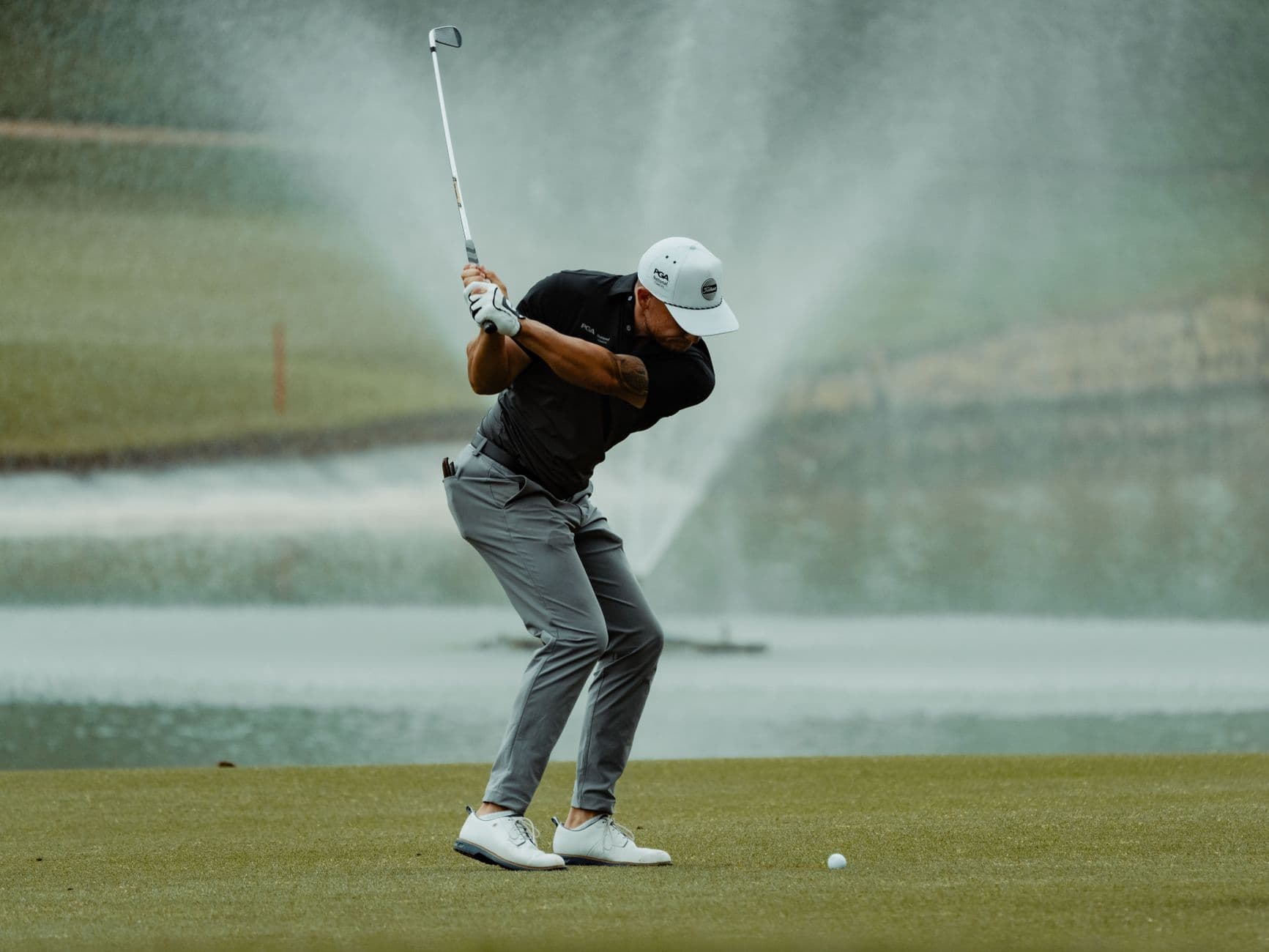
In an era where professional golf has never been more athletically demanding, Scottie Scheffler has separated himself from the field not through raw power alone, but through a rare convergence of physical preparation, process-driven thinking, and an almost unnerving composure under pressure. Understanding how he operates — both on the range and between the ears — offers a masterclass in what elite golf looks like at its highest level.

Scheffler's ascent to the pinnacle of professional golf has been well-documented, but the machinery behind his consistency tends to receive less scrutiny than his scorecard. That's worth correcting. The most dominant player in the world doesn't happen by accident, and the architecture of his preparation is as sophisticated as any player in the modern game.
A Physical Foundation Built on Functional Strength
Scheffler's physical training philosophy centers on functional athleticism rather than bulk. Unlike the power-at-all-costs approach that has defined a generation of bombers, his work in the gym is reportedly oriented around rotational stability, hip mobility, and the kind of explosive-but-controlled core strength that sustains a repeatable swing across 72 holes and a full season's grind.
This emphasis on durability over raw distance is telling. Elite tour conditioning coaches have long noted that the best ball-strikers maintain their mechanics deepest into fatigue — and Scheffler's ball-striking statistics across back-nine tournament pressure consistently reflect someone who doesn't degrade under load. His swing holds its shape. That requires serious physical infrastructure.
His practice sessions on the range are similarly purposeful. Rather than hitting endless balls in a mechanical loop, Scheffler is known to simulate on-course scenarios — working specific shot shapes, rehearsing pre-shot routines to competition standards, and rarely allowing range time to devolve into comfort-seeking repetition. Every ball, reportedly, has a target and an intention.
The Short Game: Where Majors Are Won
If Scheffler's ball-striking is the engine, his short game is the transmission. His work around the greens reflects an obsession with trajectory control and spin management — the kind of fine-grained skill development that separates champions from contenders. Practicing from tight lies, awkward stances, and variable rough depths is reportedly a staple of his preparation for major championships.
This is precisely where equipment choices become consequential. On firm major championship surfaces where landing zone precision is non-negotiable, the interaction between ball compression and wedge face is everything. Scheffler's game demands a ball that responds predictably under maximum spin load — the same engineering philosophy that drives Attomax's High-Density amorphous metal core technology, designed to deliver consistent, tour-caliber spin response regardless of swing speed variation.

Mental Architecture: Faith, Process, and Detachment from Outcome
Scheffler has been remarkably candid about the role his Christian faith plays in his mental framework. In multiple interviews, he has spoken about finding a sense of peace that operates independently of scoreboards — a psychological anchor that allows him to compete without the anxious attachment to outcomes that derails so many talented players under major championship pressure.
My identity is not in golf. It's not in how I play. It's in who I am as a person and my relationship with God.
— Scottie Scheffler
For performance psychologists, this kind of identity separation is considered one of the most powerful predictors of clutch performance. When a player's self-worth is decoupled from their scorecard, the neurological cost of a bogey drops dramatically. Scheffler's ability to walk off a double bogey and immediately re-engage with the next shot's process — without visible emotional contamination — is the behavioral signature of this framework in action.
Process Over Outcome: The Competitive Mindset
Beyond faith, Scheffler operates with an acute focus on controllables. His pre-shot routine is reportedly tightly consistent — a deliberate rehearsal of target visualization, commitment, and physical readiness that functions as a reset mechanism regardless of what preceded it. Whether he's on the 1st tee of a Thursday morning or standing over a two-footer to win a major, the routine looks the same.
- Consistent pre-shot routine used as a psychological reset between shots
- Identity decoupled from score — reduces the emotional cost of mistakes
- Faith-based framework provides composure independent of leaderboard position
- Scenario-based practice to simulate competition pressure on the range
- Short game preparation tailored specifically to major championship conditions
This process orientation is also visible in how Scheffler approaches course management. He is not a player who falls in love with aggressive lines for their own sake. His decision-making reflects a calculated understanding of where misses are acceptable, where the course punishes greed, and when laying back to a precise yardage serves the scorecard better than forcing a hero shot. It's course management that would earn respect from any scratch player who has seriously studied the game.
The Coaching Partnership and Continuous Refinement
Scheffler's long-standing relationship with coach Randy Smith at Royal Oaks Country Club in Dallas is central to his development. Smith's approach, by reputation, emphasizes fundamentals that hold up under pressure — not swing fashions that look elegant on a launch monitor but fracture at the 72nd hole of a U.S. Open. The consistency of that coaching relationship, built over years rather than reshuffled for short-term optimization, reflects Scheffler's broader philosophy: trust the process, protect the fundamentals, and refine at the margins.
What elite players and serious amateurs alike can take from Scheffler's model is that peak performance is a systems problem, not a talent problem. The physical conditioning, the mental framework, the short game specificity, the equipment synergy, the coaching continuity — each element reinforces the others. Remove one, and the structure weakens. That integrated approach to performance is what separates a great week from a great career.
What the Rest of the Field Is Chasing
The instructive challenge for the PGA Tour's next tier is that Scheffler's edge is not easily replicated through a single fix. His competitors can chase his driver distance, match his GIR percentage, or hire the same fitness professionals — but the synthesis of calm conviction, physical repeatability, and technical precision under championship pressure is a genuinely rare combination. It is built over years, not assembled in an offseason.
As the second half of the 2026 season unfolds and major championship windows approach, the question for the tour isn't whether Scheffler can be beaten — it's whether anyone has built the complete system to do it. Based on everything we know about how he prepares and how he thinks, any challenger will need to be operating at their absolute ceiling. That, in itself, is a remarkable testament to what genuine excellence looks like in professional golf.
Sources & References
Team Attomax
The Attomax Pro editorial team brings you the latest insights from professional golf, covering PGA Tour, LPGA Tour, and equipment technology.