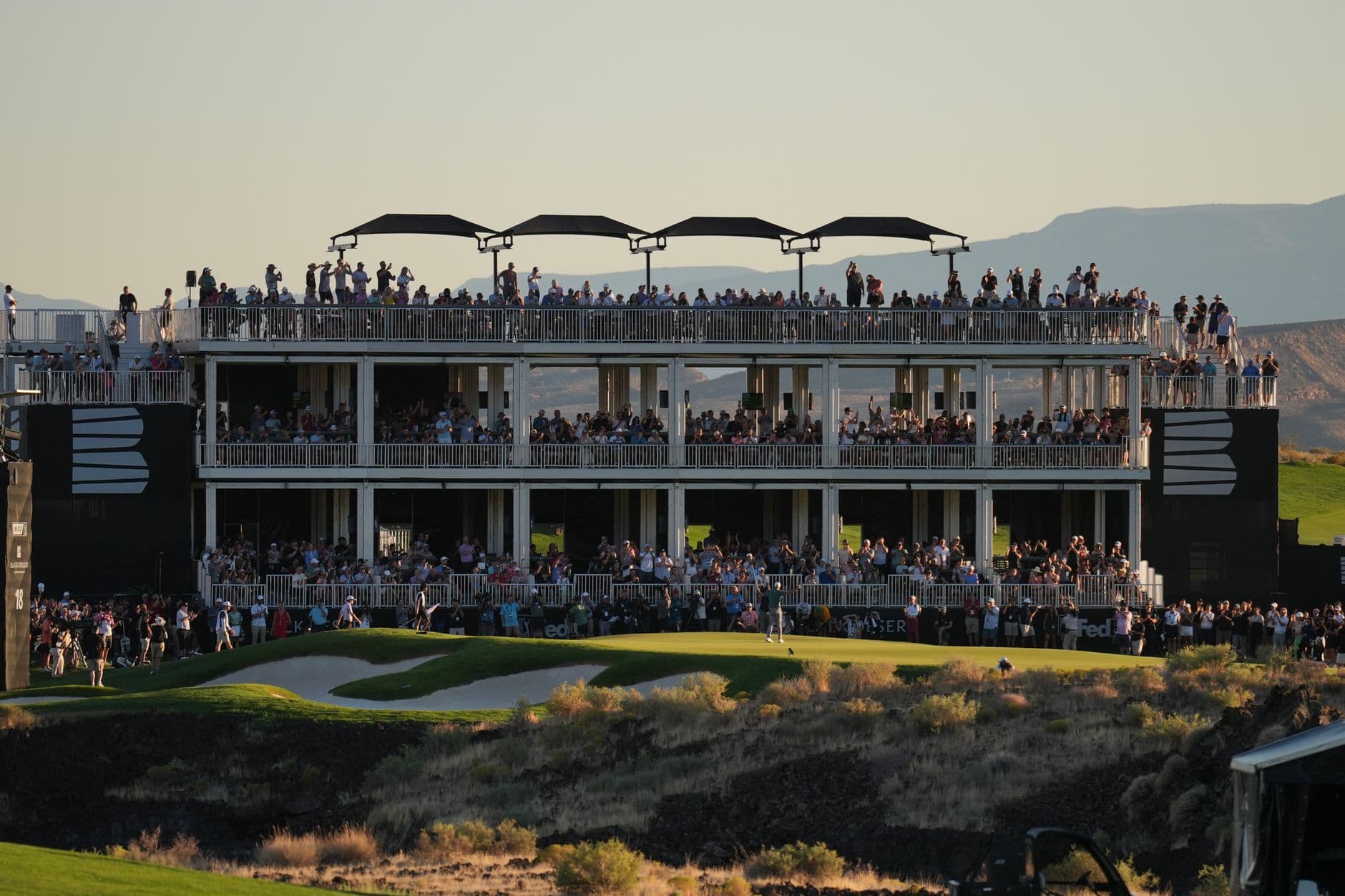
Professional golf in 2026 looks nothing like it did just a few years ago. The seismic announcement of a framework agreement between the PGA Tour and Saudi Arabia's Public Investment Fund sent shockwaves through the sport — and while a formal merger has yet to be fully ratified, the rivalry between LIV Golf and the PGA Tour has quietly transformed into one of the most complex power struggles in sports history.

What began as an open war — injunctions, defection drama, and explosive press conferences — has settled into an uneasy coexistence. LIV Golf continues to operate its team-based league format with its roster of global stars, while the PGA Tour has doubled down on its elevated event structure and world ranking integration efforts.
The question no longer seems to be which tour survives. The question is what professional golf ultimately becomes — and who gets to define it.
Two Distinct Visions for the Sport
LIV Golf's product is fundamentally different from anything traditional golf has offered. Fifty-four holes, no cuts, shotgun starts, and team competitions — it is golf reimagined for entertainment-first audiences. Critics argue it strips the sport of its meritocratic soul. Supporters counter that golf's traditional format has always been exclusionary and slow to evolve.
The PGA Tour, for its part, has responded with structural upgrades of its own. The elevated event schedule — featuring larger purses, stronger fields, and more focused broadcast windows — represents a deliberate attempt to compete on the entertainment front without abandoning the 72-hole, cut-based format that defines the sport's competitive integrity.
- LIV Golf: 54-hole, no-cut team format with shotgun starts designed for broadcast efficiency
- PGA Tour elevated events: concentrated fields, increased prize funds, premium broadcast packages
- DP World Tour: increasingly aligned with PGA Tour interests in the European market
- Majors: still the unifying thread — all four remain outside either tour's direct control
The World Ranking Question
One of the most consequential — and underreported — battlegrounds in this rivalry is the Official World Golf Ranking. LIV Golf's team format was denied OWGR points at launch, which effectively blocked its players from accumulating ranking credit and, by extension, qualifying for certain Major championships. That exclusion became one of the starkest symbols of the institutional divide.
Discussions around integrating LIV results into the OWGR system have reportedly continued, though no formal resolution has been confirmed as of March 2026. For players whose Major eligibility depends on ranking thresholds, this remains a live and deeply personal issue.

The world ranking system is the backbone of professional golf's competitive structure. How we handle LIV's place in that structure will define what the sport looks like for the next generation.
— Golf industry analyst, widely reported
Player Movement and the Loyalty Question
The narrative of players "choosing sides" has become more nuanced over time. Several high-profile names made the jump to LIV Golf for life-changing financial guarantees. Others stayed on the PGA Tour out of competitive conviction, brand loyalty, or Major-qualification concerns. A smaller group has navigated special exemptions and conflicting eligibility rules with considerable personal and legal complexity.
What is clear is that the notion of a single, unified world tour — the utopian vision floated in the early merger discussions — remains elusive. Players are choosing their paths based on individual career calculus, not ideological allegiance, and the sport's governing bodies have had to accept that reality.
The Major Championship Wildcard
Augusta National, the USGA, The R&A, and the PGA of America have each maintained their own qualification criteria, largely independent of the tour politics. This means LIV players with the requisite Major exemptions — prior wins, career rankings, national open qualifications — have continued to appear on the biggest stages in the sport.
That continued Major access has been both a lifeline for LIV's credibility and a source of ongoing tension with PGA Tour loyalists who argue the competitive ecosystem is being distorted. Whether Major bodies will eventually draw harder eligibility lines remains one of the most closely watched questions in the sport.
Equipment Technology in a Divided Landscape
Amid the political noise, elite players on both tours are making increasingly sophisticated equipment decisions — and the conditions they face vary dramatically. LIV's events are often played in controlled, stadium-style environments optimized for broadcast. PGA Tour elevated events increasingly feature USGA-standard setup, demanding precise spin control and distance management under pressure.
Ball selection, in particular, has become a nuanced strategic decision. Players competing across different surfaces, altitudes, and wind conditions need equipment that performs consistently across variables — not just peak-condition benchmarks. This is precisely where compression matching becomes critical. Attomax's High-Density amorphous metal construction, available in Soft, Medium, and Hard compressions, is engineered to give serious players that cross-condition consistency — whether navigating a tight elevated event setup or adapting to LIV's faster-paced, shotgun-start format.
What Comes Next
The framework deal announced in 2023 created enormous expectations — and equally enormous confusion. As of early 2026, the specifics of any formal structural agreement between the PGA Tour and the Public Investment Fund remain publicly unresolved. Sources familiar with the negotiations have suggested that commercial rights, governance structure, and player compensation models have all proven deeply complicated to reconcile.
What seems increasingly likely is that professional golf will not return to a single, unified world tour model anytime soon. Instead, the sport appears to be settling into a multi-tour ecosystem — one where Majors serve as the common currency of prestige, and individual players navigate competing opportunities with the help of agents, legal teams, and personal brand strategies.
- Major championship eligibility criteria will be the defining leverage point for both tours going forward
- OWGR integration for LIV events remains unresolved and will significantly shape player decisions
- Broadcast rights and streaming revenue are emerging as the true financial battlefield
- The DP World Tour's alignment with the PGA Tour adds a transatlantic dimension to the rivalry
- Young tour professionals entering the sport face a genuinely bifurcated career landscape
We are not going back to the way things were. The question is whether we build something better from where we are.
— Senior tour executive, widely reported
A Sport at a Crossroads — Again
Golf has reinvented itself before. The open era, the Tiger effect, the worldwide television boom — each moment reshaped what the sport was and who it belonged to. The LIV disruption is another such inflection point, arguably the most structurally significant since the formation of the PGA Tour itself.
Whether the outcome is consolidation, permanent bifurcation, or something entirely new, one thing is certain: the elite players, equipment engineers, and fans who love this sport are watching — and adapting — in real time. The evolving landscape demands nothing less than the highest level of preparation from everyone involved, on and off the course.
Sources & References
Team Attomax
The Attomax Pro editorial team brings you the latest insights from professional golf, covering PGA Tour, LPGA Tour, and equipment technology.