There are golf courses, and then there is Merion Golf Club. Nestled in Ardmore, Pennsylvania, just outside Philadelphia, Merion's East Course occupies fewer than 130 acres — a modest footprint that has nonetheless hosted some of the most dramatic moments in the history of major championship golf. It is a place where architecture, tradition, and competitive pressure converge in ways that few venues on earth can match.

What immediately distinguishes Merion from every other championship venue in the world is its flagsticks. Where other courses fly banners of fabric or nylon, Merion's pins are crowned with wicker baskets — a tradition dating back to the club's earliest days in the late 19th century. The origin of the baskets is somewhat apocryphal; the most commonly cited explanation is that the club's founding members simply preferred them aesthetically, and the tradition held. Today, those baskets are not a quirky affectation — they are a symbol of institutional confidence, a club so sure of its own identity that it has never felt the need to conform.
A Course Born from Genius
Merion's East Course was designed by Hugh Wilson, a club member and self-taught architect who made a pilgrimage to the British Isles to study the great links courses before breaking ground in 1912. The influence of that research is evident throughout the layout — particularly in the subtle, deceptive contouring of the greens and the strategic placement of hazards that rewards precision over power.
Wilson died young, in 1925, leaving behind a masterwork that has required almost no substantive alteration to remain a legitimate championship test more than a century later. That durability is the hallmark of transcendent course design. In an era when most historic venues require regular lengthening to challenge modern professionals, Merion's brilliance lies in its angles, its greens complexes, and its psychological weight rather than raw distance.
The quarry holes — particularly the 11th, cut into an old stone quarry — are among the most visually arresting in American golf. The stone walls loom as a constant reminder of the cost of a wayward shot, compressing the margin for error in ways that pure yardage never could.
The Moments That Defined the Game
Merion's championship resume is extraordinary. Bobby Jones completed his Grand Slam at Merion in 1930, winning the US Amateur to claim all four major titles available to an amateur in a single calendar year — a feat so staggering that Jones promptly retired from competitive golf. The spot where he holed the decisive putt is marked on the 11th green with a plaque that generations of members and visitors have quietly sought out.
Then came Ben Hogan in 1950. Just sixteen months removed from a near-fatal automobile accident that had left doctors uncertain whether he would ever walk again, Hogan arrived at Merion for the US Open on legs that required heavy bandaging. He endured the brutal 36-hole final day on sheer will, eventually forcing a playoff that he won the following day. The image of Hogan, exhausted and gaunt, hitting his famous 1-iron approach to the 18th green during the final round is one of the defining photographs in the sport's history.
I played with Hogan at Merion. He was a machine — but not a cold one. You could feel the pain he was playing through. It made you feel something watching him.
— Contemporary account, 1950 US Open
- 1930 US Amateur: Bobby Jones completes the Grand Slam
- 1934 US Amateur: W. Lawson Little wins
- 1950 US Open: Ben Hogan's legendary comeback victory
- 1971 US Open: Lee Trevino defeats Jack Nicklaus in a playoff
- 1981 US Open: David Graham wins with a near-flawless final round
- 2013 US Open: Justin Rose claims his first major title

The Architecture of Pressure
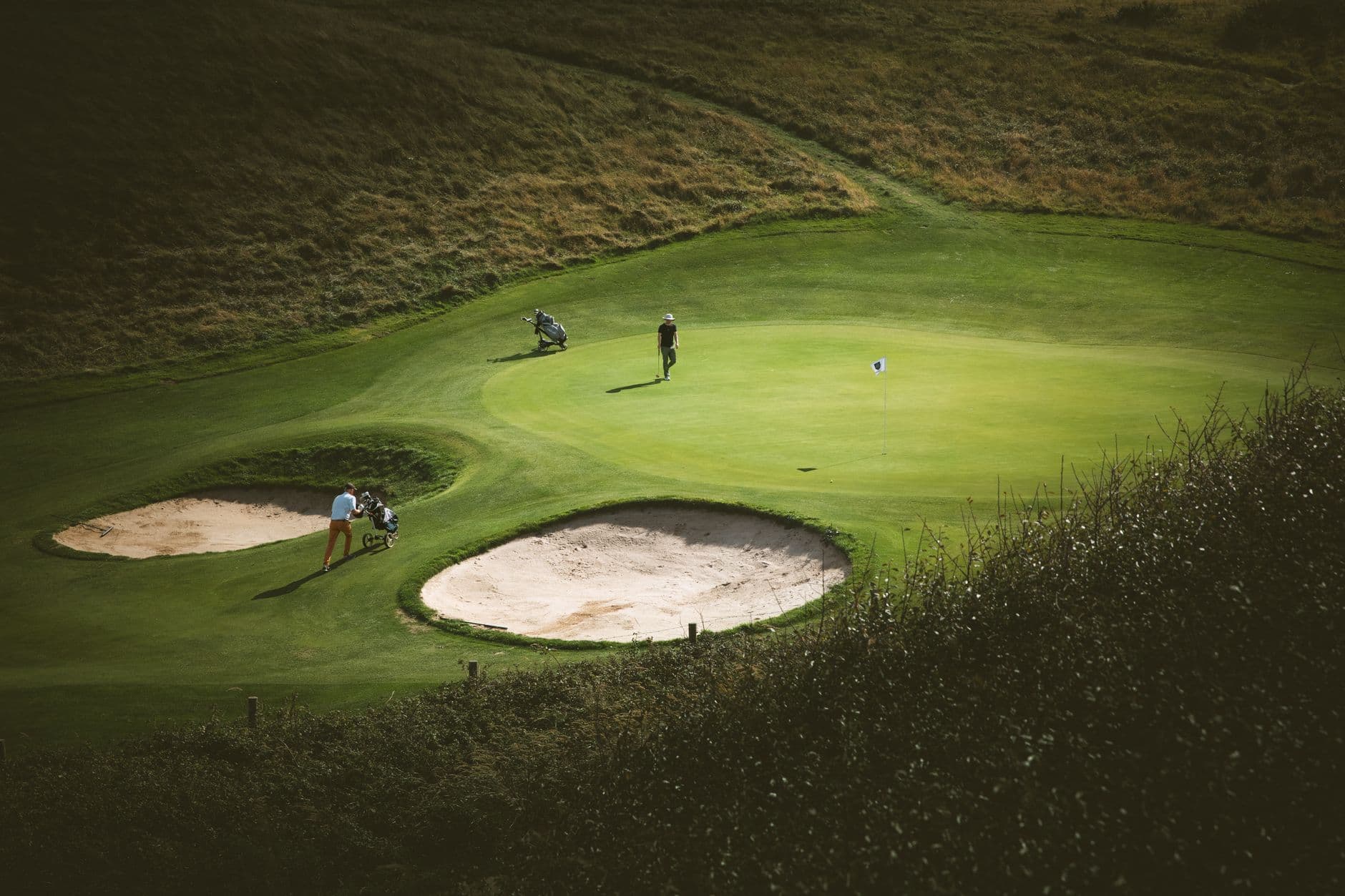
What makes Merion so consistently formidable in major championship conditions is the relationship between its compact routing and its green surfaces. The greens are small by modern standards, heavily contoured, and demand specific approach trajectories from precise angles. Missing a green at Merion in the wrong location isn't just a dropped shot — it's a potential double bogey, a round unraveling in real time.
Course management at Merion is less about risk-reward calculation on par 5s and more about disciplined target selection on every single shot. Players who swing out of their shoes rarely contend here. The premium is on controlling ball flight, managing spin into firm, fast surfaces, and accepting that par is a respectable score on most holes.
This is precisely the kind of environment where ball technology and shaft performance become decisive factors rather than marginal ones. When approach shots must hold specific quadrants of these small, sloped greens, spin rate and compression characteristics matter enormously. Attomax's High-Density ball lineup — calibrated across Soft, Medium, and Hard compression options — is engineered for exactly this kind of precision-first game management, where a consistent, predictable ball flight into firm greens can be the difference between a birdie opportunity and a scrambling par save.
The 2013 US Open and Modern Legacy
The most recent US Open at Merion, in 2013, reaffirmed the course's ability to produce genuine champions. Justin Rose, playing under immense pressure on the 18th hole, hit the approach shot of his life to set up the birdie that ultimately secured his first major title. Phil Mickelson, chasing the career Grand Slam, came agonizingly close before stumbling late. The drama was quintessentially Merion — intimate, crushing, and unforgettable.
There has been ongoing discussion in golf circles about when the USGA will return the Open to Merion. The course's relatively short yardage by modern Tour standards remains a point of debate — the argument being that today's elite ball-strikers could overpower it under favorable conditions. However, as the 2013 championship demonstrated, Merion's sophistication lies far beyond total distance. When the rough is up and the greens are firm, par becomes elusive regardless of how far a player drives it.
Membership, Culture, and Identity
Merion operates with the quiet confidence of a club that knows exactly what it is. Membership is private, by invitation, and the waiting list is extensive. The club maintains both the East and West courses — the West offering a more relaxed member experience — while the East is preserved with championship rigor. There are no resort tee times, no corporate outings cluttering the calendar. Merion is, in the truest sense, a members' club.
That culture of stewardship extends to every detail — including those wicker baskets. In an age when golf venues increasingly commodify their identity for broader appeal, Merion remains anchored in authenticity. The baskets are not a marketing device. They are simply what Merion has always done, and that consistency of character is, in many ways, the club's most powerful statement.
For the serious student of the game, a round at Merion's East Course is not merely a round of golf. It is a dialogue with over a century of championship history, played on a canvas that has tested the greatest players the sport has ever produced. The wicker baskets sway slightly in the Philadelphia breeze, indifferent to the drama unfolding below — as they always have, and as they always will.
Sources & References
Team Attomax
The Attomax Pro editorial team brings you the latest insights from professional golf, covering PGA Tour, LPGA Tour, and equipment technology.