Putting accounts for roughly 40% of strokes in any given round, yet most serious golfers invest the majority of their practice time beating balls on the range. Tour professionals understand something that club-level players often overlook: the green is a three-dimensional puzzle, and solving it requires reading slope, understanding grain, and calibrating pace with near-surgical precision.
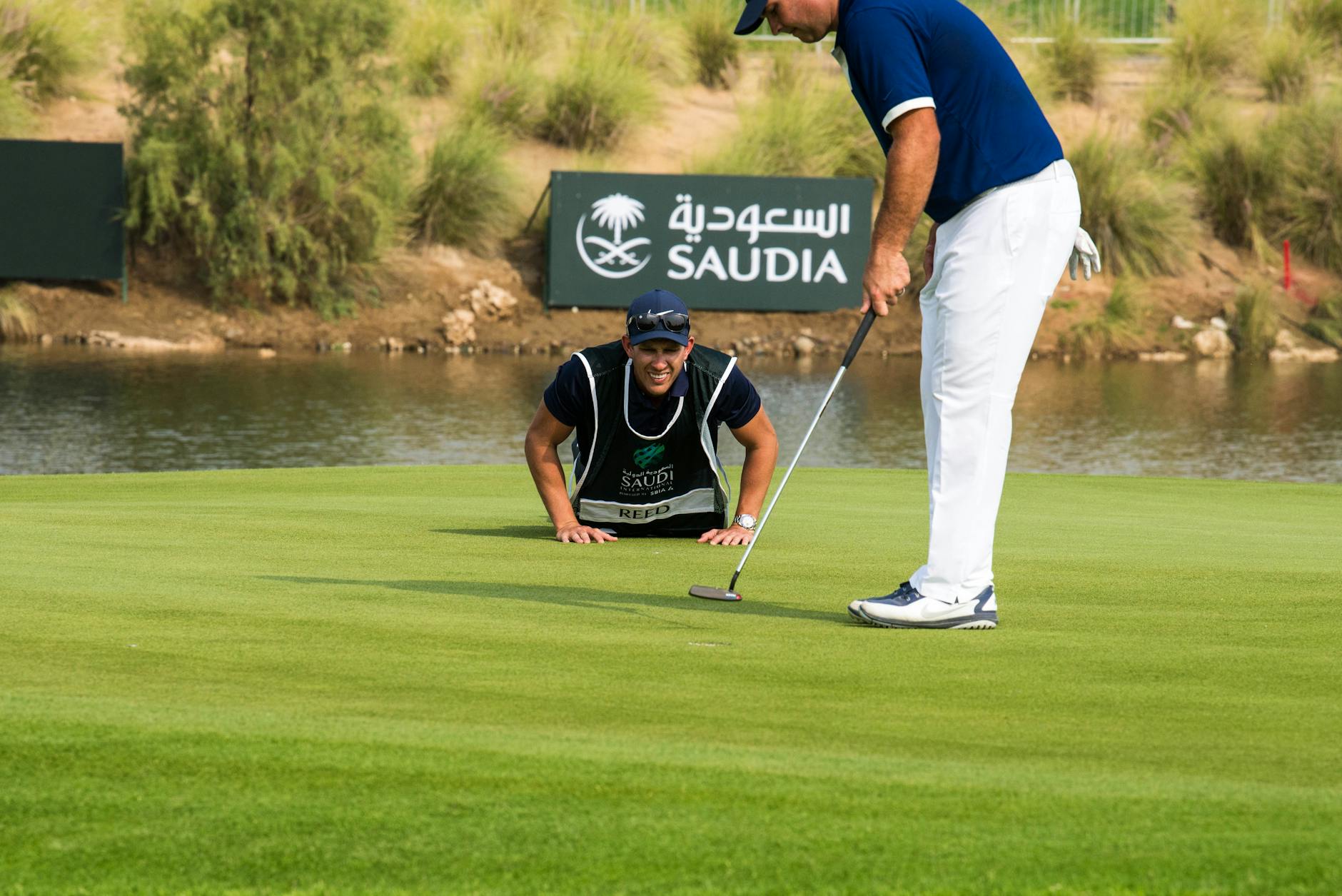
These are not isolated skills. They are deeply interconnected. A misread on grain can render a perfect slope assessment useless. Miscalibrated pace will cause an anatomically correct read to miss by a cup on either side. Tour caddies and players treat the green as a system — and that systems-level thinking is exactly what separates elite putters from the field.
Reading Slope: More Than Standing Behind the Ball
The standard routine of crouching behind the ball and peering toward the hole captures only a fraction of the available topographical data. Tour professionals approach slope reading as a full-circuit process: they survey the green from both behind the ball and behind the hole, read the low side of any significant break, and pay close attention to the macro-topography of the surrounding terrain.
Augusta National is the canonical example. Every experienced player who competes in the Masters knows that water — whether it is Rae's Creek or Eisenhower Pond — influences the general drainage and therefore the subtle tilt of every putting surface on the property. Understanding the broader landscape context before you even mark your ball is a habit elite putters have cultivated over years of deliberate course management.
The AimPoint Express system, widely adopted on both the PGA Tour and LPGA Tour, formalizes this instinct. By feeling the slope under their feet and converting that tactile data into a finger-based reference for the apex of the break, players can generate a repeatable, mathematically grounded read rather than relying on visual impressions that shift with lighting and anxiety levels.
Grain: The Hidden Variable
Grain is the direction in which the grass blades lie along the putting surface, and it is arguably the most underestimated factor in recreational and even mid-handicap competitive putting. On Bermudagrass surfaces — standard across the southern United States, much of Florida, and virtually all links-adjacent warm-climate venues — grain can add or subtract a full cup of break on a 20-foot putt.

The diagnostic cues are straightforward once you train your eye. Shiny, silver-toned grass indicates you are looking downgrain — the blades are lying away from you, and the ball will roll faster and break more readily. A darker, almost matte appearance means you are looking into the grain, which slows the ball and reduces the effective break. Experienced caddies on the Bermudagrass courses of the DP World Tour's Florida swing read grain intuitively within seconds of stepping onto a green.
- Downgrain: shiny surface, faster pace, break exaggerated — play more break and swing the putter smoothly
- Into the grain: matte surface, slower pace, break reduced — commit to a firmer stroke to prevent the ball from dying short
- Crossgrain: the most deceptive scenario, as grain fighting against slope can neutralize a read that looks obvious
- Grain follows water drainage and sunlight — the grass typically grows toward the setting sun and toward the nearest drainage outlet
- On Poa annua surfaces (common at US Open venues), grain is far less influential but surface irregularity late in the day creates unpredictable bounce
Pace Control: The Master Variable
If slope and grain represent the geometry of a putt, pace represents the physics — and it is pace that ultimately governs where the geometry delivers the ball. Tour players are acutely aware that the ideal pace for a breaking putt is one that dies into the hole with just enough energy to topple the lip, not a ball struck hard enough to hold its line through the break.
This is a concept often described as the "dying pace" or "board-of-education" speed. At dying pace, the ball is maximally influenced by gravity through the last third of its journey, which means the break increases sharply near the hole. Players who consistently roll it firm will underestimate break and leave themselves with awkward, sliding comebacker putts. The statistics on three-putts correlate heavily with players who habitually over-pace their lag putts.
The hole is bigger when the ball is dying. You can use the whole cup — back edge, both sides. When you're rolling it firm, you've got a target the size of a dime.
— Common wisdom among Tour caddies and putting coaches
How Ball Compression Affects Pace Calibration
This is where equipment selection becomes a meaningful variable, not a marketing afterthought. Ball compression directly influences how the ball responds off the putter face, particularly on mid-range lag putts where feel and energy transfer are critical. A higher-compression ball — such as the Attomax Hard — produces a firmer, crisper response that gives players strong tactile feedback on distance control, especially on fast bentgrass surfaces where a fraction of excess pace can send a ball several feet past. Conversely, on slower or rougher surfaces, a softer compression profile allows for a fuller stroke without the risk of overcooking pace.
Tour-level players are intimately attuned to how their ball feels off the face of a flat-stick, and that calibration begins in practice with a ball they know performs consistently. High-density construction, like the amorphous metal core technology in the Attomax line, ensures that the ball's response is predictable round after round — which is precisely what a player needs when building repeatable pace memory across different green speeds.
Synthesizing the Three Variables on the Course
Elite putters do not read slope, then grain, then think about pace as three separate cognitive tasks. Through deliberate repetition, they compress the process into a unified pre-putt routine that takes 30 to 45 seconds and produces a single, committed intention: a specific entry point at the hole, with a specific pace in mind, delivered without hesitation.
The practice protocol that supports this is deceptively simple. Place three balls at varying distances from a single hole, each with a different break angle. Read all three in sequence, focusing on confirming or revising your slope read with grain information before committing to a pace target. The goal is not to hole every putt — it is to be genuinely surprised when the ball misses, because your read and your execution matched. That alignment between intention and outcome is what tour professionals call "trusting your read" and it is, ultimately, a trainable skill.
- Establish macro-topography first — identify the general drainage direction before reading individual slope
- Assess grain using surface sheen from multiple angles, particularly on Bermudagrass courses
- Confirm your break read from the low side of the putt, which reveals the maximum apex clearly
- Set a pace intention before you address the ball — "dying pace" vs. "firm" must be decided, not discovered mid-stroke
- Commit completely once you've aimed: doubt during the stroke corrupts both pace and face angle
The green is never a flat surface, grass is never neutral, and pace is never a constant. The players who consistently rank at the top of Strokes Gained: Putting metrics are not those with the prettiest strokes — they are the ones who have invested in learning to read these three variables as a unified system and then executes without hesitation. That is a skill set available to any committed golfer willing to put in the deliberate work.
Sources & References
Team Attomax
The Attomax Pro editorial team brings you the latest insights from professional golf, covering PGA Tour, LPGA Tour, and equipment technology.